I'm at an age in life where I think often about how much things have changed over the years. When I was six my mom remarried and we moved into a 140 year old house with no indoor bathroom. We had an outhouse, and a chamber pot for night time use that I had the job of emptying each morning.
My mom and stepdad took showers at his parents house about a mile away, but we youngsters took our baths in a galvanized washtub in the middle of the kitchen, that same tub was what my mom washed our clothes in outside using a washboard. Eventually we added a small bathroom to the house with a bathtub, toilet and sink, and my mom was able to get a ringer washer for doing laundry. It stayed outside on the porch.
We were farmers, we had a little less than others around us, but not much. I didn't know of any friends who still used an outhouse, but I didn't think of us as poor at the time. Compare those times to today where I live a pretty normal life with all the standard comforts. Internet, smart phones and laptop computers are accepted as normal among most of the people I know
That was the early 1960's, in the early 1970's is when I began my martial arts journey. Consider the differences in mine and most others lifestyles from today to 60 years ago, and to the martial arts world of today compared to 50 years ago. So much has changed.
I have many colleagues and associates today that have trained as long or longer than I have. Grandmaster Joseph Jones, 8th Dan, who owns Little Union Academy of Martial Art in Kinston NC has become a good friend of mine and of our program at Shelton Martial Arts Academy in recent years. He trained directly under Richard Chun in the early 1960's, nearly ten years before I took my first class. Grandmaster Chuck Heck, also 8th Dan, who owns a school in Kentucky has also trained longer than I have, both of these gentlemen are friends to many of our students and visit us several times a year. There are many others.
In spite of our age, the loss of youthful ability, the affect of accumulated injuries, and coping with the many changes we've experienced, we happily continue. We're still training and teaching because we love it.
That's now, then we were young and most of us have at least a photo or two taken at a demonstration showing us breaking stacks of wood or bricks, throwing someone around, or, the favorite, flying through the air in a side kick. Those things were fun, but also expected. We had tradition to follow and live up to that required we represent our art well. Part of that was demonstrating the physical abilities we developed. Much emphasis was placed on tradition in those days. Many of us, including me, believed we were practicing something that had existed for 5,000 years, and doing it pretty much the same way it had been taught all that time. We took much pride in being adherents of "the real thing". It's true that there was in fact a tradition of sorts going back for centuries, but it was a bit confusing to me when I learned that Tae Kwon Do, as practiced under that name, only came to be after World War II, in the early 1950's. Official Tae Kwon Do is about as old as I am, though what became Tae Kwon Do predates that by many years.
There are lots of twists, turns, and detours leading to what we practice today, and if you study it (I have a pretty decent library at the dojang) it makes lots of sense. Much of the influences were due to national pride, particularly Korean after the Japanese occupation of Korea ended in 1945, but also due to the different skills and gifts that different practitioners offered, and their personal philosophies toward training. There are many, many books available that explore all of this regarding Korean development of the arts of Tae Kwon Do, Tang Soo Do, Hapkido, etc. The same is true of martial arts with roots in other countries, Kung Fu in China, Karate in Japan, and others.
My personal focus has been primarily Tae Kwon Do but supplemented with the study of Hapkido. Taekwondo today, especially as practiced by the Kukkiwon, World Taekwondo is completely different from what I learned and from what I teach. In 1971, the year I began training, Taekwondo was designated the national sport of South Korea. As it developed as a sport, there were constant changes in the rules of competition, techniques were changed to be effective for scoring points instead of emphasizing lethality in a combat encounter. Due to these changes Taekwondo became an official medal sport in the Olympics in 2000, it had been a demonstration sport there since 1988.
We all have things we like, and we are often at least a little resistant to change once we've gotten comfortable with something. I never wanted to pursue the changes that were implemented to go from combat based Tae Kwon Do to sport Taekwondo, (notice, even the stating of the name merged to one word by combining the three). My original Grandmaster, Dr. Dae Shik Kim was supportive of the move to sport but believed it should be recognized as something different. He advocated a separation, with the older Tae Kwon Do still being recognized as a martial art and the newer Taekwondo as a martial sport.
Many people will tell you they practice "Traditional" Tae Kwon Do. What I observe and I think can be supported is, what they initially trained in became their "Tradition". My instructors tradition was a little different than mine, students training today will have a much different base to consider as traditional. There are core tenets that I still hold dear as passed down from my first instructors, respect one another, develop a high level of skill, find your own strengths and weaknesses and understand how to work with them, learn to be confident and to control any nervousness or fear, and use what you learn as a gift to yourself but even more to others, to share and teach for them to benefit from your knowledge.
Beyond that, as my early day of outhouses and baths in a galvanized tub in the kitchen floor are gone, so are the way I trained compared to how I now have to teach. My insurance requires limitations on contact and students must wear protective equipment if engaged in contact sparring. That equipment didn't exist in my early days, and we sparred under what we called medium contact. Unintentional broken noses, black eyes, busted lips, and cracked ribs were not uncommon. Classes were mostly young men and we didn't even concern ourselves with those injuries as we got them anyway playing backyard football, wrestling, and roughhousing.
There were no classes for kids then, the idea would have been considered reckless and dangerous. There were no women in the beginning of the program I was in, and it was years before there were women black belts. That's so strange to think about now with our classes usually about 50/50 male/female.
There is no one right way or even best way. The tradition of martial arts is change. Change comes from new knowledge, borrowing from other arts, strong personalities who want things done a certain way, political reasons within large organizations, and for us old timers, learning how to continue and work with the limitations of age, accumulated injuries, and just societal changes. You would never have heard a snicker, or even a peep, from a student during class in the 70's, the formality and discipline were strong. Our instructors were not abusive or heavy handed, but they were serious and we knew they would not tolerate any slackness.
In the half century that I've been involved in martial arts I've always wanted to explore beyond just my dojang training. I've read extensively, done research papers for rank advancement, and taken advantage of those who could teach me history, philosophy, and theory. I was very fortunate that Dr. Kim not only published great books for anyone to read, but also was very open to share his knowledge with me personally in the last decade or so of his life. I know many of the students and instructors I came up with over the years weren't interested in some of those thing, but then again, I'm still standing and they left their training years ago. That part doesn't seem to have changed much. It's challenging to generate any interest among students to read about the broader and deeper aspects of martial arts technique, philosophy, and history. I offer some in class but can only touch on it there due to time constraints.
I know most people who see this are not too interested in all of this, but maybe a couple are and will read all the way to here. For those few I say, I know there are many things to pursue in life, and many of those offer huge benefits, but at least consider what some additional exploration of the many paths presented by martial arts study may offer. One of the sad but very common things my colleagues and I discuss when talking about our students is how so many set their goal of becoming a black belt, reach that goal, and then move on as if it was just an accomplishment to check off. Black belt is the end of beginner 101 and the beginning of beginner 102. The ones who leave at that point may find great rewards in what they leave for, but they never know the rewards they left behind.
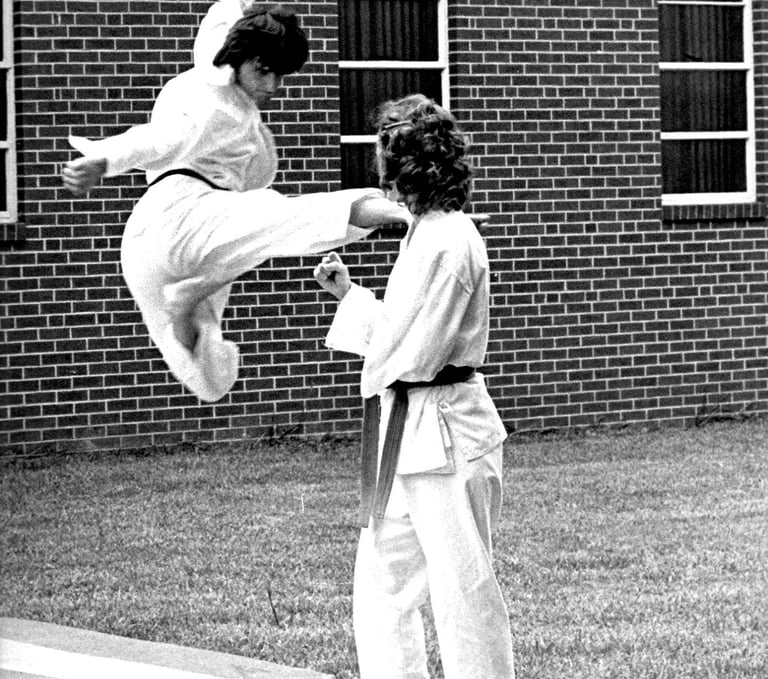
Master Sam at age 21 (all of us old timers have photos like this)
My Journey
General Pondering
1/19/20246 min read