
Advancing in Rank
Promotions
12/11/202410 min read

Promotion Guidelines and Ranking Information
The following information is being made available to help students, and family of younger students, better understand what is required to advance in rank in our programs. There will be steps and needs to be addressed individually with students over time, but this should give everyone a good general understanding.
Most people begin martial arts training with the idea of eventually obtaining a black belt. While that’s an important goal, there are other belts that are just as important to be earned along the way.
The ranking system can vary among schools, but it pretty much serves the same purpose wherever it’s followed. Having different colored belts allows students to focus on smaller, more reachable goals as steps on their journey to black belt. There are three major ranking divisions leading to black belt, and they are 1) white/yellow, or beginner, 2) green/purple/blue, or intermediate, and 3) red/brown, or advanced. In many competitions these would be the main divisions for those not yet black belt. For rank advancement these divisions are further broken down to a total of 10 subdivisions called Gups and these allow students to receive recognition every few months as motivation to continue the journey toward the longer-term goal of black belt and beyond.
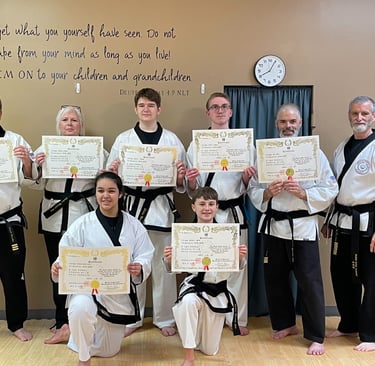
At Shelton Martial Arts Academy we schedule promotions approximately every three months. Students who attend enough classes or who put in hours outside of class to make up for classes missed, can usually advance one rank every 3 months in the beginner and intermediate ranks. Advancement may slow down in the higher ranks as performance requirements are more demanding. It’s not uncommon for a student to wait six, nine, or more months to advance at those levels.
It's also the practice at Shelton Martial Arts for students to be evaluated by instructors in the weeks prior to scheduled promotions. Students who are deemed not prepared, or whose skill and knowledge don’t meet the requirements to advance, will be advised that they are not eligible for the “test”. That way no one should fail the “test”, and it becomes a demonstration of skill and knowledge and a celebration of advancement, and therefore a promotion instead of an actual test.
In years past, tests were really tests and many students failed them. The disappointment of failing before their peers was hard and some would just stop training afterward. Now, there is no public failure, students are simply told they aren’t ready to advance. Then they can continue training to overcome any deficiencies pointed out by their instructor and advance when they are ready. The results are the same, but the disappointment is less, and the public embarrassment is avoided. If you as a student are advised that you aren’t ready to promote, it’s not an insult or a criticism, it’s an opportunity to speak with the instructors about what is needed to prepare for the next promotion.
Students advance at different rates for many reasons. Some students attend nearly every class. As this document is being written there are students attending our classes four times each week. Most are not able to attend that much, but some of those train diligently on their own and make up for those classes they can’t attend. Still others are just not able to put the time in, but still attend once or twice weekly and work hard in class. Those will also advance but perhaps not as quickly as those putting in much more training time.
The journey to black belt with Shelton Martial Arts for students who train regularly and consistently will range on average from three to four years. It can take much longer depending on time and effort devoted to training. On the other hand, a student who trains very diligently can conceivably reach the goal of black belt in around two years, though that is rare.
Requirements for Advancement
We’ve had a set of advancement requirements for some time, published in a student manual. I’m retiring that manual now and replacing it with this document. I believe this will be more helpful in guiding students as they study, train, and advance through the belt system.
The colors of belts are just representations of rank, the real ranking system is called the “Gup” system for the ranks below black belt. The black belt ranking system is called the “Dan” system for students aged 15 and older and “Poom” for students under age 15. Beginner students are automatically 10th gup, or novice, represented by a white belt. The colors of the belts change as students advance over time through the gups to 1st gup, or brown belt. There is then a rank called “Provisional Black Belt”. The belt for that rank is black and red and is intended to represent a maturing period, both mentally and physically, to prepare for the responsibility of being considered for advancement to black belt status. Upon promotion to black belt students receive a First Dan, or First Poom certificate, depending on their age.
Shelton Martial Arts Academy does not adhere to a set curriculum of learning certain techniques for each level of advancement. Beginners will be exposed to the same techniques that the black belts perform. While they are not expected to execute the advanced techniques, they can begin experimenting with them over time. It’s not the number of kicks, strikes, or other techniques that are the prime indicator of growth in ability, it is the way those techniques are performed. Growth in performance is determined by the delivery of the techniques. This includes among other things how smooth, quick, powerful, and accurate their delivery is. The ability to put together combinations and apply them effectively while sparring and performing one steps is a measure of advanced understanding and growth that are considered for rank advancement. It’s the responsibility of the master instructor to evaluate each students’ growth and provide guidance.
Upon achieving black belt level, advancement slows, and without some special exception it takes years to advance from one rank to another. For example, the minimum time to advance from 1st to 2nd degree is one year, the minimum time to advance from 4th degree to 5th degree is 4 years, and from 7th degree to 8th degree is 8 years. There are minimum age requirements as well as the youngest someone can promote to 9th degree, the highest rank in our system is age 53.
I was 1st Dan for 7 years and 6th Dan for 13 years, and for my age and when I started, that’s normal. In fact, the minimum age requirement for black belt in my organization when I began training was 21 (that was my instructors’ personal rule). A lot has changed over the years as Taekwondo has become much more structured and has grown internationally to include classes for all ages.
The titles of Master and Grandmaster are associated with higher levels of black belt, and they vary a great deal among different martial arts organizations. In the associations that certify Shelton Martial Arts Academy black belts, the title of Master is awarded with the promotion to 4th Dan and remains through 6th Dan. When promoting to 7th Dan one is eligible for the title Grandmaster if they demonstrate a very high level of knowledge, skill, teaching ability, and dedication to the art, and remain active through teaching and promoting the art. Simply passing the 7th Dan exam doesn’t necessarily result in being awarded the Grandmaster title.
Promotion Day
Our promotion event follows the same basic format each time with students required to demonstrate basic techniques, poomsae (forms), one steps, sparring, and breaking.
Basics: students will be required to demonstrate any of the basic striking, blocking, and kicking techniques they have learned in class, along with proper use and application of stances and movement.
Poomsae: each student must demonstrate at least three forms, the one that is required for the rank being promoted to, and the two for the immediately preceding ranks. Students are responsible to know all forms they have learned but absolutely must be able to demonstrate these three properly. See below:
Forms Required by Rank
For Little Kickers (and some of the younger students in Moo Duk Kwan Kids), forms are not required, but students will be given the opportunity to demonstrate any that they have learned.
Moo Duk Kwan Kids and Adults
Kicho Ilbo, Kicho Eebo, and Kicho Sambo – for Yellow Stripe, 9th gup
Taegeuk Il Jang - Yellow Belt, 8th gup
Taegeuk Ee Jang - Orange Belt, 7th gup
Taegeuk Sam Jang - Green Belt, 6th gup
Taegeuk Sah Jang - High Green Belt, 5th gup
Taegeuk Oh Jang – Purple Belt, 4th gup
Taegeuk Yook Jang – Red Belt, 3rd gup
Taegeuk Chil Jang – High Red Belt, 2nd gup
Taegeuk Pal Jang – Brown Belt, 1st gup
Koryo - Red/Black Belt (Provisional black belt); also for 1st Poom/Dan
These are minimum requirements; students should be prepared to demonstrate any form they have previously learned.
One Steps
Students will demonstrate at least five one steps of their choosing, at least three should include a takedown. Younger students below green belt may do a minimum of 3 one steps.
Self Defense
Students will demonstrate at least three self-defense techniques in addition to the one steps performed.
Sparring
Students will be required to spar at least one, two-minute round.
Breaking
Students will be required to break at least one board with a hand strike or kick. Beginning at second gup they may be required to break either two or three unspaced boards with a strike or kick. Younger students will break ¼ inch boards. Older students and adults will break 1-inch boards.
Younger Students and Striped Belts
In martial arts programs of my early days, it was rare to find a student younger than their mid-teens in a class, and everyone was treated the same. Today most students are younger than that and a ranking system had to be developed to support the youngest of them. Shelton Martial Arts has a separate system to accommodate our younger students, and requirements for the kids are based on their age and developmental abilities. We will work with smaller kids where they are and strive to prepare them to advance into the adult ranking system when they are capable of functioning at that level. White they remain in the striped belt system we deal with each one individually as they are able to perform and let them benefit from the exercise and direction they receive in class. If they continue with their study, they can also eventually reach black belt level, but it could take several years.
Also…
Advancement is not a matter of checking off boxes by learning the steps to the required forms, having an adequate number of one steps, and meeting the other basic requirements.
There is an intangible that only an instructor with adequate experience can judge, and that is the quality of performance in all areas. Students regularly hear about the proper way to position themselves in stances, what the proper movement and resting position of the chambering hand is, and how to chamber arms and legs before and after delivering strikes, blocks, and kicks. These skills are constantly refined over time as students practice and grow in skill and knowledge. Instructors with many years of experience can walk into a school where students are practicing, and even if they are not wearing belts indicating rank, can tell approximately what rank each student is, just by observing the way they perform basic techniques.
So, it really is up to the testing authority, or school master, to determine what belt a student should wear to reflect where he or she fits in overall skill and knowledge within the ranking system of the school. If the student is assigned a rank that doesn’t reflect their skill level, it puts them, and possibly the other students, in an awkward position. Rank is earned and then awarded by the school master instructor who has the responsibility to fairly evaluate each student. Sometimes that results in accelerated promotions and other times it’s determined the best thing for a student is to work longer at their current level and not promote beyond their ability to perform.
Special Circumstances Promotions
In my younger days most martial arts students were young men along with just a few women. We were all fit and strong didn’t mind working and fighting hard, women included. The bottom line for testing for black belt was that even if you could perform all the forms and techniques, if you could not stand and fight the toughest guy in class, you would not be promoted to black belt. You didn’t have to beat him; you just had to fight him and not give up thereby demonstrating the will and resilience deemed a requirement in those days.
One fellow student of mine in the 1970’s was a surgeon. An obviously bright and talented fellow, but he had some coordination issues, and his overall technique just never developed to a very high level. Plus, as a surgeon, he was very protective of his hands and limited himself in certain areas due to that. At one point our head instructor pulled him to the side and advised that while he respected and admired the doc, he would never promote beyond green belt as he seemed stuck at that level of performance. To his credit the doc was fine with that and continued to train for many years, never advancing beyond green belt as far as I know.
Another student, a young man in his late teens, had a profound palsy of some sort. His movements were very spastic, and I honestly had much difficulty understanding him when he spoke. His performance of poomsae was difficult to follow and his basics were very awkward. Surprisingly he was a very good fighter which I never understood. He seemed very capable when it came to explosive movement. He was also a great guy and was well liked and admired by all who knew and trained with him. Because of his disability he was not eligible to be promoted to black belt. While he could fight, that was about the only thing he could perform at really well even though he was devoted and worked exceptionally hard. We were advised by our Grandmaster at the time that advancement rules limited him to no higher than 3rd gup, red belt.
While those rulings were sad for us, we accepted them as did the students affected directly by them. That was then, and now things are different. We currently have a Special Circumstances exception to the old rule. We are permitted to consider all the circumstances we are aware of about a student when looking at them for promotion. A student’s effort, drive, and demonstrated determination and commitment can offset physical limitations. Students with special needs, physical handicaps, even those who are wheelchair bound, have at least the possibility of advancing in rank all the way to black belt.
-------------------------------------
Life is full of decisions and choices. If a student has the desire, can find the time to train, has the dedication to meet the challenges of learning, and has a love for the art, they may be one of the few who complete the journey to black belt. Not all schools and dojangs are the same. We have our own culture and standards at Shelton Martial Arts. We strive to support each student in their training and encourage them to continue the journey. Some will make it a lifetime pursuit, but even those who train for a time and then move on to other things will hopefully find they benefitted from their time with us.